
Tim Robinson has built the kind of entertainment career that looks almost accidental from the outside. He became famous by making ordinary social situations feel completely unhinged, turning awkward conversations, workplace frustrations, bad decisions, and tiny moments of embarrassment into elaborate comedy.
But behind the shouting, bizarre costumes, and increasingly ridiculous sketches is a much more conventional professional story: years of improv training, television writing, acting, producing, and carefully developed creative partnerships.
As of 2026, Tim Robinson’s net worth is commonly estimated at around $2 million, although there is no publicly audited figure confirming his personal wealth. Celebrity wealth websites vary considerably, which is why the $2 million figure should be treated as an estimate rather than a verified financial statement.
Robinson, now 45 years old, has moved well beyond his early television work. His résumé includes Saturday Night Live, Detroiters, the Emmy-winning I Think You Should Leave with Tim Robinson, the 2025 film Friendship, and HBO’s The Chair Company. HBO renewed The Chair Company for a second season in November 2025, giving Robinson another major platform for his distinctive style.
There is also an important clarification for people searching for “Tim Robinson musician,” “Tim Robinson rapper,” or asking about his music style: the Tim Robinson associated with the $2 million net-worth estimate is primarily an American comedian, actor, writer, and producer—not a hip-hop artist. Several musicians share the name, including artists listed on Spotify and Apple Music, so search results can easily become mixed together.
Tim Robinson Net Worth at a Glance
| Category | Details |
|---|---|
| Full Name | Tim Robinson |
| Date of Birth | May 23, 1981 |
| Age in 2026 | 45 |
| Birthplace | Detroit, Michigan, U.S. |
| Nationality | American |
| Profession | Comedian, actor, writer, producer |
| Best Known For | I Think You Should Leave with Tim Robinson |
| Major Earlier Work | Saturday Night Live, Detroiters |
| Estimated Net Worth | About $2 million |
| Spouse | Heather Robinson |
| Children | Two |
| Active Since | 2011 |
| Major Streaming Home | Netflix |
| Recent Series | The Chair Company |
The biographical details above are based on publicly available biographical and entertainment records; the net-worth number remains an estimate rather than a disclosed personal financial figure.

What Is Tim Robinson’s Net Worth in 2026?
The most frequently cited estimate places Tim Robinson’s net worth at approximately $2 million.
That number makes sense in the broad context of his career, but it shouldn’t be presented as if Robinson himself has published a bank statement or financial disclosure. Celebrity net-worth calculations generally attempt to estimate earnings from acting, writing, producing, television contracts, and other professional activity. They do not provide a direct look into someone’s assets, taxes, debts, investments, or private contracts.
Other websites have produced much wider ranges, including estimates below $1 million. That disagreement is actually useful because it highlights how uncertain celebrity net-worth figures can be.
A reasonable editorial approach, therefore, is to describe $2 million as a widely reported estimate, not an independently verified fact.
Where Does His Money Come From?
Robinson’s income is best understood as a combination of several entertainment careers rather than one giant paycheck.
His work has included:
- Television acting
- Television writing
- Sketch-comedy creation
- Executive producing
- Streaming-series work
- Film acting
- Residual and licensing-related income
- Creative collaborations and production
The distinction matters. Robinson isn’t simply the performer who appears on camera. On his most important projects, he has been involved behind the scenes as a writer, creator, or executive producer as well.
That broader creative ownership can make a career considerably more valuable over time.
How Old Is Tim Robinson?
Tim Robinson was born on May 23, 1981, making him 45 years old in 2026. His birthplace is Detroit, Michigan.
His age has become a surprisingly common search topic because Robinson’s appearance and deliberately awkward comedic persona don’t fit the traditional image of a television celebrity.
He’s also experienced a somewhat unusual career trajectory. Rather than becoming a household name in his twenties and then maintaining that fame, Robinson spent years developing his craft before his most recognizable work became a cultural phenomenon.
That makes the age question more interesting than it initially appears.
At 45, Robinson isn’t a young newcomer trying to break into comedy. He’s an established writer-performer who has entered another stage of his career, where his name itself can help launch a project.
Tim Robinson’s Early Life and Background
Robinson was born in Detroit and grew up in Michigan. Public biographies identify his father as a construction worker and his mother as having worked for Chrysler. He graduated from Clarkston High School in 2000 and began taking improv classes at the Detroit branch of Second City.
That Second City connection is significant.
For many American comedians, improv isn’t just a place to learn how to make people laugh. It’s a training ground for timing, character development, ensemble performance, and the ability to build a scene from a tiny idea.
Robinson eventually performed with Second City in Detroit and Chicago, developing the skills that would later become central to his television work.
His comedy often feels spontaneous, but there’s considerable technical discipline underneath it.
A character may appear to be losing control, yet the scene itself usually has a very deliberate escalation. Someone makes a strange comment. Another character reacts. The situation gets worse. Then Robinson pushes it several steps beyond what a normal sitcom would allow.
That rhythm became one of his trademarks.
Tim Robinson’s Career Journey
The Second City Years
Robinson’s professional development began in the improv world rather than through instant television success.
Second City gave him access to a community of performers and writers who would become important to his later career. His Detroit roots also remained central to his creative identity.
That regional perspective would eventually become one of the defining features of Detroiters, his Comedy Central series with Sam Richardson.
The Saturday Night Live Break
Robinson’s next major step was Saturday Night Live.
He joined the show as a featured player for the 2012–2013 season and later moved more heavily into writing. His relationship with the program lasted several years, with the Television Academy listing him as a 2016 nominee for Outstanding Writing for a Variety Series.
His SNL experience is important because it gave him something that improv alone couldn’t provide: exposure to the machinery of a major national television production.
But Robinson’s story also demonstrates something unusual about his career.
Being a cast member on Saturday Night Live is often treated as the ultimate goal for an aspiring sketch comedian. Robinson instead found that his strengths were particularly well suited to writing and developing material outside the traditional late-night format.
That decision helped shape everything that followed.
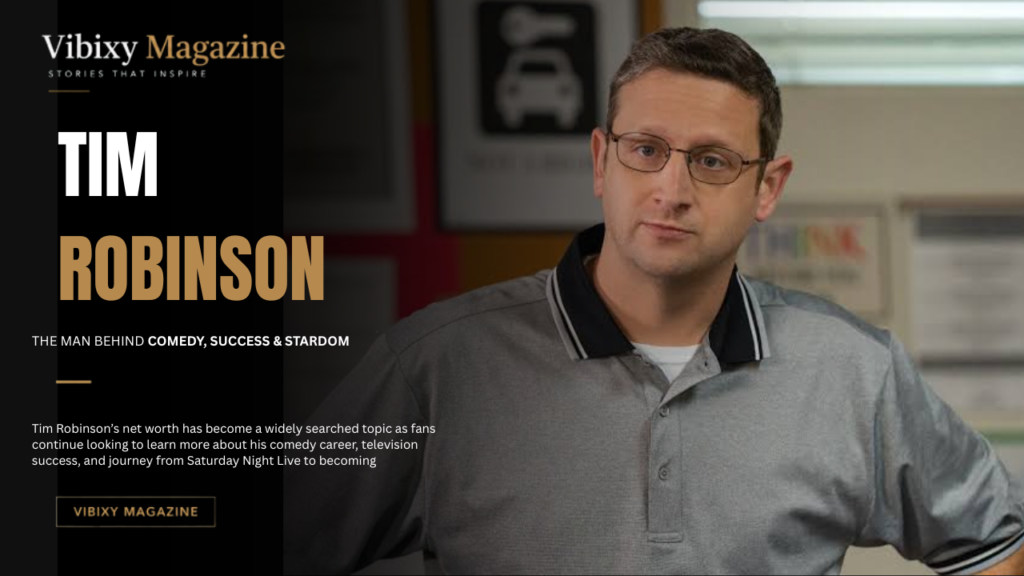
Detroiters and the Sam Richardson Partnership
After SNL, Robinson teamed up with fellow comedian Sam Richardson to create Detroiters.
The Comedy Central series ran for two seasons from 2017 to 2018. It followed two lifelong friends trying to build careers in Detroit’s advertising world.
The premise sounds simple. The execution wasn’t.
Detroiters allowed Robinson to combine absurd characters with a surprisingly affectionate portrayal of his hometown. The show wasn’t merely making jokes about Detroit; it used the city as part of its identity.
That distinction became important.
Robinson’s work often feels grounded in recognizable environments—offices, suburbs, restaurants, parties, family gatherings—before slowly pushing those environments into complete chaos.
That formula would become even more effective on Netflix.
The Breakthrough: I Think You Should Leave
If SNL introduced Robinson to the television industry and Detroiters established his creative identity, I Think You Should Leave with Tim Robinson turned him into a cult-comedy star.
The Netflix series debuted in 2019 and was created by Robinson and Zach Kanin. Netflix describes it as an offbeat sketch series built around bizarre and mundane situations, with Robinson, Andy Samberg, and Sam Richardson among its principal performers.
There are currently three released seasons.
And the show’s success is difficult to explain using conventional sitcom logic.
The sketches frequently begin with something ordinary: a business meeting, a dinner, a conversation between strangers, a social gathering. Then a character becomes slightly unreasonable.
Instead of backing down, the character doubles down.
Then doubles down again.
Suddenly the audience is watching a social disaster that bears almost no resemblance to the original situation.
That’s Robinson’s territory.
Why the Show Became So Popular
The show’s greatest advantage may be that its jokes work both as television and as internet culture.
Individual scenes can be clipped, quoted, screenshotted, remixed, and turned into memes without requiring viewers to understand an entire episode.
That has helped the series travel far beyond traditional television audiences.
The Guardian previously observed how scenes from I Think You Should Leave became part of the social-media conversation, including the famous hot-dog-car sketch.
Years after its debut, the show’s sketches continue to circulate online.
That’s a valuable form of cultural longevity.
A sitcom can have strong ratings and disappear. A sketch can become a reaction image that people use years later.
Robinson’s comedy has repeatedly achieved the second kind of life.
Tim Robinson’s Emmy Success
Critical recognition eventually followed the cult audience.
The Television Academy records show that Robinson won the 2022 Emmy Award for Outstanding Actor in a Short Form Comedy or Drama Series for I Think You Should Leave with Tim Robinson. He was credited as playing various characters.
The series itself was also nominated in the short-form comedy category, with Robinson among its executive producers.
The Emmy mattered for more than prestige.
Awards can change how the entertainment industry views a creator. A performer who was once primarily associated with weird internet comedy suddenly has an award-winning résumé.
That can translate into stronger negotiating power, more opportunities behind the camera, and greater freedom to develop original projects.
For Robinson, that progression appears particularly important because his career has increasingly moved toward creator-led projects.
The Chair Company and the Next Chapter
Robinson’s career didn’t stop with I Think You Should Leave.
HBO ordered The Chair Company, a comedy created by Robinson and Zach Kanin. Robinson stars as William Ronald Trosper and also serves as a writer and executive producer.
The first season premiered in October 2025 as an eight-episode series. Its premise follows a man who becomes involved in investigating a far-reaching conspiracy after an embarrassing workplace incident.
That premise sounds remarkably compatible with Robinson’s established comedic universe: an ordinary problem that becomes increasingly impossible to contain.
More significantly, HBO renewed the series for a second season in November 2025.
For Robinson’s career and potential future earnings, this is one of the most relevant developments.
A successful recurring series gives a creator a different kind of stability from a collection of guest appearances.
Tim Robinson’s Movie Career
Robinson has also expanded into feature films.
One of the clearest examples is Friendship, the 2025 A24 comedy starring Robinson and Paul Rudd. A24 describes the film as the story of suburban dad Craig, whose intense attempt to become friends with his charismatic new neighbor threatens to destroy both men’s lives.
The casting makes sense.
Robinson is especially effective when a character is emotionally sincere while behaving in a way that becomes increasingly inappropriate. Pairing that energy with a mainstream comic actor such as Paul Rudd creates a natural contrast.
Friendship is also evidence that Robinson’s appeal has moved beyond sketch comedy.
The more interesting question now is whether his distinctive style can continue to work in longer formats without losing what made the sketches special.
What Makes Tim Robinson’s Comedy Different?
Calling Robinson’s work simply “absurdist comedy” doesn’t quite capture it.
His characters usually want something very normal.
They want to look competent.
They want other people to respect them.
They want to win an argument.
They don’t want to admit they made a mistake.
They want to fit in.
And then something happens that threatens that ordinary goal.
Instead of accepting the embarrassment, they fight against reality itself.
That’s where the comedy explodes.
His performances often involve exaggerated frustration, sudden shouting, awkward physicality, strange voices, and increasingly desperate attempts to control a situation.
But underneath the absurdity is a very recognizable human emotion: the fear of looking stupid in front of other people.
That may be one reason his sketches connect so strongly with internet culture.
Everyone has experienced an awkward conversation.
Most people simply don’t respond by destroying the entire social environment around them.
Robinson’s characters do.
Is Tim Robinson a Rapper or Musician?
This is one of the areas where online searches can create confusion.
There are multiple musicians named Tim Robinson listed on major music platforms. Apple Music, for example, has separate artist pages under the name Tim Robinson, including releases such as Juno, Indigo, and Never too late. Spotify also lists a Tim Robinson artist profile with songs and albums.
Those music profiles should not automatically be attributed to the comedian.
The Tim Robinson behind I Think You Should Leave, Detroiters, Friendship, and The Chair Company is primarily known as a comedian, actor, writer, and producer.
He has participated in music-related comedy and contributed to songs within his television work, but that is very different from having a conventional career as a recording artist.
So if someone searches “Tim Robinson music style,” the safest answer is: his defining artistic style is sketch comedy, particularly absurdist and cringe comedy—not hip-hop or mainstream music.
Tim Robinson’s Personal Life
Robinson has generally kept his private life away from the center of his public career.
He is married to Heather Robinson, and public biographical sources report that they have two children.
Compared with many contemporary entertainers, Robinson maintains a relatively low-key public profile.
That fits his personality as a performer.
His work is loud.
His public persona is much quieter.
There is a useful distinction between a comedian who turns their entire private life into content and a comedian who creates fictional worlds and characters. Robinson belongs much more strongly to the second category.

Tim Robinson on Social Media
Robinson’s influence online is much larger than what his personal social-media activity alone would suggest.
His sketches have become reaction images, memes, quotes, short clips, and references across social platforms. The online afterlife of I Think You Should Leave has arguably become part of the show’s cultural identity.
That matters because modern entertainment fame isn’t measured only by followers.
A comedian can have a relatively modest personal social presence while having enormous cultural reach through clips shared by fans.
Robinson is a particularly strong example of that phenomenon.
People may not follow him directly, but they recognize the hot-dog car, the increasingly bizarre arguments, the facial expressions, and the strange lines from his sketches.
The character becomes the social-media currency.
Why Are People Searching for Tim Robinson’s Age and Net Worth?
Two searches often appear together: age and net worth.
That’s not unusual when a celebrity experiences a second wave of popularity.
Robinson’s career started more than a decade ago, but I Think You Should Leave introduced his work to a much broader audience. Younger viewers encountering him through memes may naturally wonder who he is, how old he is, and how long he’s been working.
His current projects have added another layer.
With Friendship and The Chair Company, people who originally knew Robinson from short sketches now have more reasons to search his biography.
The result is a familiar internet cycle:
A performer becomes culturally relevant → clips spread → new viewers search the name → biography and age searches rise → net-worth searches follow.
It’s less about celebrity gossip than curiosity.
People want to understand the person behind the face they’ve suddenly started seeing everywhere.
Tim Robinson Career Timeline
| Year | Career Milestone |
|---|---|
| 1981 | Born in Detroit, Michigan |
| 2000 | Graduated from Clarkston High School |
| Early 2000s | Began developing comedy through Second City |
| 2011 | Began receiving notable television opportunities |
| 2012 | Joined Saturday Night Live as a featured player |
| 2013–2016 | Continued writing for SNL |
| 2017 | Detroiters premiered on Comedy Central |
| 2018 | Detroiters ended after two seasons |
| 2019 | I Think You Should Leave premiered on Netflix |
| 2021 | Second season of I Think You Should Leave released |
| 2022 | Robinson won a Creative Arts Emmy |
| 2023 | Third season of I Think You Should Leave released |
| 2024 | HBO ordered The Chair Company |
| 2025 | Friendship released; The Chair Company premiered |
| 2025 | HBO renewed The Chair Company for Season 2 |
| 2026 | Robinson remains an established creator, actor, writer, and producer |
Interesting Facts About Tim Robinson
He didn’t follow the conventional SNL path
Many performers dream of becoming an SNL cast member. Robinson ultimately benefited from becoming a writer and creator as much as from being on camera.
Detroit remains part of his creative identity
His Detroit background isn’t merely a biographical footnote. It became central to Detroiters and contributes to the grounded, regional feel of his comedy.
His biggest show is built around short sketches
I Think You Should Leave doesn’t depend on long story arcs. Netflix describes it as a short-form sketch comedy series, with episodes built from multiple bizarre situations.
He is an Emmy-winning performer
Robinson’s 2022 Emmy win gave formal industry recognition to a style that had already developed a passionate fan base.
He has moved increasingly behind the camera
Writing and executive producing are major parts of Robinson’s modern career, especially on projects such as The Chair Company.
His comedy has a strong meme life
The fact that individual sketches continue circulating online years after release is a significant part of his cultural influence.
What Could Increase Tim Robinson’s Net Worth in the Future?
The strongest potential driver is continued creator ownership.
There is a major difference between being hired to act in somebody else’s show and creating, writing, producing, and starring in your own series.
Robinson increasingly operates in the second category.
The renewal of The Chair Company gives him another opportunity to develop a television property with his creative partner Zach Kanin.
Film work could also expand his profile. Friendship demonstrated that his particular brand of comedy can move into feature-length storytelling and work alongside established actors such as Paul Rudd.
There’s also the possibility of additional writing and producing projects.
For a creator like Robinson, the most valuable asset may not be any single acting paycheck. It is the recognition attached to his name and the ability to develop material that only he could plausibly make.
Why Tim Robinson’s Career Matters in Modern Comedy
Robinson’s rise says something larger about how comedy has changed.
Traditional television rewarded performers who could fit recognizable formats.
Streaming has made more room for creators with highly specific voices.
Robinson’s work is extremely specific.
It’s not designed to please everybody. That’s part of its strength.
The humor can be loud, uncomfortable, juvenile, surreal, strangely detailed, and deeply awkward. Yet those characteristics have helped him build a recognizable artistic identity.
In an era when countless entertainers compete for attention, being immediately identifiable is valuable.
You can watch a few seconds of a Robinson sketch and often know it’s his.
That’s difficult to manufacture.
Frequently Asked Questions About Tim Robinson Net Worth
What is Tim Robinson’s net worth?
Tim Robinson’s net worth is commonly estimated at around $2 million as of 2026. However, no official public financial statement verifies that figure, so it should be regarded as an estimate rather than a confirmed net worth.
How old is Tim Robinson?
Tim Robinson was born May 23, 1981, making him 45 years old in 2026. He was born in Detroit, Michigan.
What is Tim Robinson famous for?
He is best known for creating, writing, and starring in Netflix’s I Think You Should Leave with Tim Robinson. He is also known for Saturday Night Live, Detroiters, Friendship, and The Chair Company.
Is Tim Robinson a rapper?
No. The comedian Tim Robinson is primarily an actor, comedian, writer, and producer. There are other musicians named Tim Robinson on streaming services, which can create confusion in search results.
Did Tim Robinson win an Emmy?
Yes. The Television Academy lists Robinson as the 2022 winner for Outstanding Actor in a Short Form Comedy or Drama Series for I Think You Should Leave with Tim Robinson.
Is Tim Robinson married?
Public biographical sources report that Tim Robinson is married to Heather Robinson and that they have two children. He generally keeps his family life private.
What is Tim Robinson’s most famous show?
His most recognizable project is I Think You Should Leave with Tim Robinson, which premiered on Netflix in 2019 and has three released seasons.
What is The Chair Company?
The Chair Company is an HBO comedy series created by Tim Robinson and Zach Kanin. Robinson stars as William Ronald Trosper, a man who begins investigating a conspiracy after an embarrassing workplace incident. HBO renewed the series for a second season in 2025.
What movie did Tim Robinson star in with Paul Rudd?
Robinson starred alongside Paul Rudd in Friendship, a 2025 A24 comedy directed and written by Andrew DeYoung.
Why is Tim Robinson so popular online?
His sketches translate unusually well to social media because they contain memorable expressions, short dialogue exchanges, recognizable social situations, and highly exaggerated reactions. Fans can share individual moments without needing the entire episode for context.
Final Thoughts on Tim Robinson Net Worth
The most interesting thing about Tim Robinson’s net worth isn’t the estimated $2 million figure itself.
It’s how he got there.
Robinson didn’t become successful by chasing the safest version of comedy. He spent years learning improv, working in writers’ rooms, performing on Saturday Night Live, developing Detroiters, and eventually creating a style so specific that audiences could recognize it almost instantly.
Then I Think You Should Leave changed the scale of his career.
What looked like strange, aggressive sketch comedy became something much bigger: a collection of characters and moments that escaped the show and entered internet culture. An Emmy followed. Film opportunities followed. HBO came calling.
Now, at 45, Robinson is in an intriguing phase of his career. He’s no longer simply the oddball comedian people discovered on Netflix. He’s an established creator with producing credits, a successful television identity, film experience, and another HBO series already renewed.
So while the exact number behind Tim Robinson net worth will remain uncertain unless he publicly discloses his finances, the broader story is much easier to see.
He built a career by making embarrassment funny, turning ordinary human insecurity into absurd spectacle—and, somehow, convincing millions of people that they weren’t the only ones who found it hilarious.