
There are components in modern engineering that rarely get attention outside of machining workshops and industrial design floors, yet they quietly decide how precise, efficient, and reliable entire production systems become. The Winkelbohrspindel is one of those components.
At first glance, the word itself feels technical, almost intimidating. In German engineering terminology, “Winkel” means angle, “bohr” refers to drilling, and “spindel” translates to spindle. Put together, a Winkelbohrspindel is essentially an angular drilling spindle—an engineered device designed to drill or machine at non-linear angles where conventional straight spindles simply cannot reach.
But reducing it to a definition doesn’t do justice to its real-world importance. In modern CNC machining, aerospace component manufacturing, automotive assembly systems, and precision tooling industries, this small yet powerful mechanism solves problems that would otherwise require multiple setups, manual repositioning, or even completely different machines.
What makes it interesting is not just its mechanical function, but the philosophy behind it: precision without compromise in constrained spaces. That idea is what has made the Winkelbohrspindel a quiet cornerstone of advanced manufacturing.
Understanding the Winkelbohrspindel in Modern Engineering
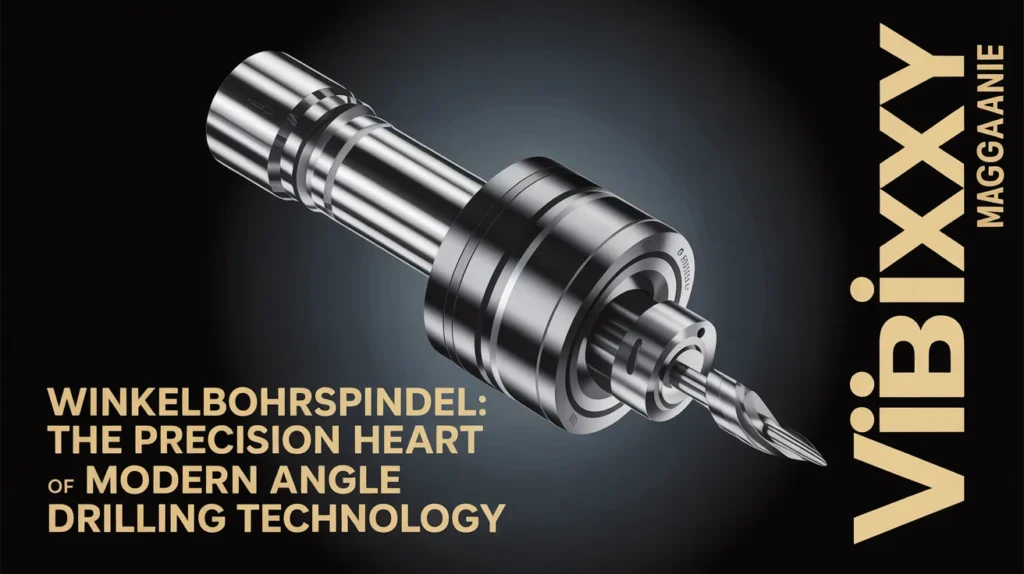
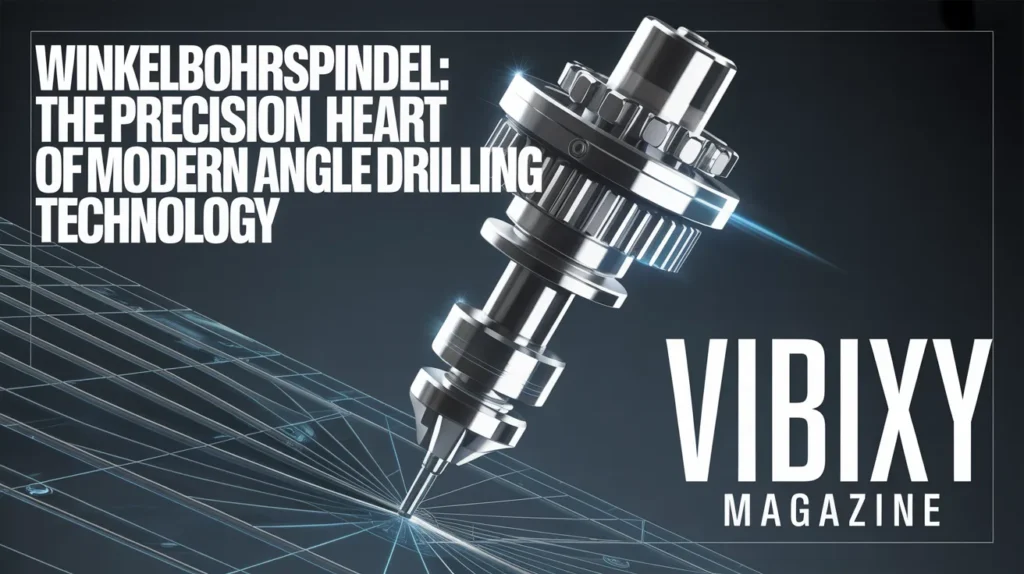
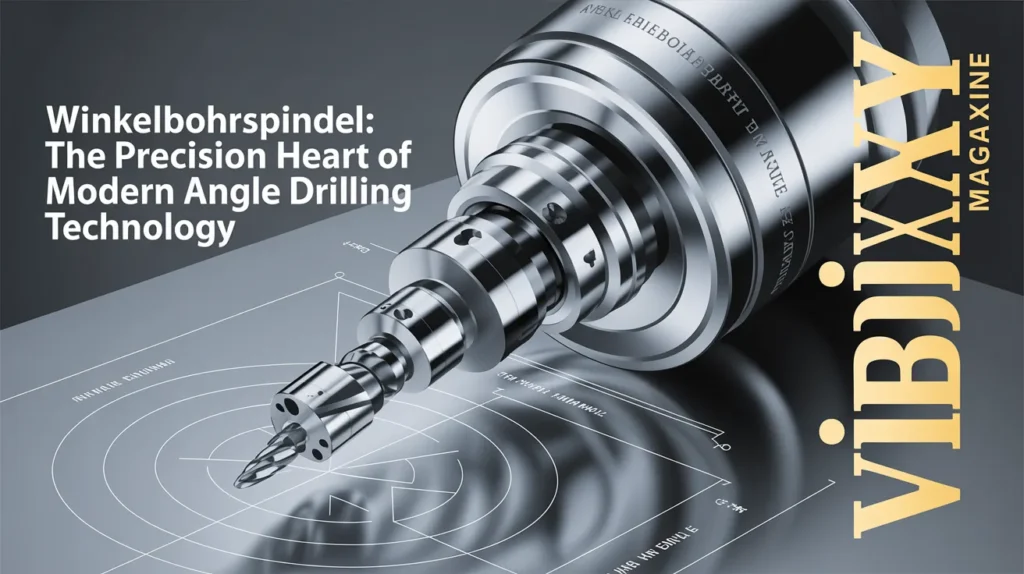
A Winkelbohrspindel is a specialized spindle attachment or integrated unit designed to transmit rotational force at a defined angle, usually 90°, though customizable variants exist.
Instead of drilling directly forward like a standard spindle, it redirects torque through internal gearing systems—commonly bevel gears or hypoid gear arrangements—allowing the tool to reach surfaces that are not directly aligned with the machine’s main axis.
This is particularly useful in:
- Deep cavity machining
- Automotive engine blocks
- Aircraft structural frames
- Complex mold manufacturing
- Tight-space industrial assemblies
In simple terms, it acts like a mechanical extension of human flexibility—reaching where a straight tool cannot.
The Development Journey of Winkelbohrspindel Technology
Unlike consumer-facing technologies, the Winkelbohrspindel didn’t “trend” in the traditional sense. Its evolution came from industrial necessity.
Early machining systems relied heavily on rigid, straight-line drilling methods. As product designs became more complex—especially after the industrial expansion of automotive and aerospace manufacturing—engineers faced a recurring issue: how to drill inside restricted geometries without repositioning the entire workpiece.
This challenge led to early angled drilling attachments in the mid-20th century. These were initially bulky, noisy, and limited in torque transmission. However, with the rise of CNC systems in the late 1970s and 1980s, precision engineering took a leap forward.
The modern Winkelbohrspindel evolved into:
- Compact high-torque gear-driven units
- CNC-compatible modular spindle heads
- High-speed precision-balanced systems
- Thermally optimized industrial components
Today, it is a refined blend of mechanical engineering, materials science, and digital machine control.
Technical Profile of the Winkelbohrspindel
Instead of a “biography” in the traditional sense, it makes more sense to view the Winkelbohrspindel as a technical entity with its own structured identity.
Technical Overview Table
| Feature | Description |
|---|---|
| Primary Function | Angular drilling and machining |
| Common Angle | 90° (custom angles available) |
| Drive System | Bevel or hypoid gear transmission |
| Compatibility | CNC machines, machining centers |
| Materials | Hardened steel, alloy housings |
| Speed Range | Low to high RPM (model dependent) |
| Cooling | Air or liquid cooling systems |
| Precision Level | High-precision industrial grade |
| Maintenance | Lubrication-based servicing |
This structured configuration allows manufacturers to integrate the spindle into highly automated environments without redesigning entire machining systems.
How the Winkelbohrspindel Actually Works
At the core of the Winkelbohrspindel lies a simple but powerful principle: redirecting mechanical force without losing efficiency.
Inside the spindle housing, rotational motion enters through the main drive shaft. This motion is then transferred through precision-engineered gear sets that change the direction of rotation—commonly by 90 degrees.
What makes this process remarkable is not the direction change itself, but how little energy is lost in the process. High-end spindle systems maintain torque consistency even under heavy machining loads.
Key internal components include:
- Input drive shaft
- Bevel gear assembly
- Output spindle shaft
- Bearing system for load distribution
- Lubrication chamber for heat reduction
Each of these parts must operate in perfect synchronization. Even minor misalignment can lead to vibration, reduced accuracy, or premature wear.
Industrial Applications of Winkelbohrspindel
The real value of a Winkelbohrspindel becomes clear when you look at where it is used.
Automotive Manufacturing
Engine blocks and transmission housings often require drilling at precise internal angles. A Winkelbohrspindel allows manufacturers to perform these operations without repositioning heavy components.
Aerospace Engineering
Aircraft structures demand extreme precision. Components like wing ribs, fuselage frames, and support brackets often require angled drilling in confined spaces.
Mold and Die Production
Injection molds and die-casting tools rely heavily on internal cooling channels. These channels are rarely straight, making angular drilling essential.
Heavy Machinery
Industrial machines often have structural reinforcements and internal cavities where angled machining is unavoidable.
Why Winkelbohrspindel Is Becoming More Relevant Today
Interestingly, the Winkelbohrspindel is not a new invention, but its relevance has increased dramatically in recent years.
This shift is driven by three major industrial trends:
1. Complex Product Design
Modern products—especially in automotive and aerospace sectors—are no longer simple geometric structures. They involve compact, multi-layered internal architectures.
2. CNC Automation Growth
As CNC systems become more autonomous, modular attachments like angled spindles are increasingly essential for multi-operation machining.
3. Space Optimization in Manufacturing
Factories are moving toward compact production lines. Machines that can perform multiple tasks without repositioning workpieces are highly valuable.
Advantages and Limitations
Like any engineering tool, the Winkelbohrspindel comes with strengths and trade-offs.
Advantages
- Enables machining in tight or inaccessible spaces
- Reduces need for multiple setups
- Improves production efficiency
- Enhances machining flexibility
- Compatible with automated systems
Limitations
- Higher maintenance requirements compared to straight spindles
- Potential torque loss in lower-end models
- Increased initial cost
- Requires precise calibration
Despite these limitations, its benefits in industrial environments often outweigh the drawbacks.
Maintenance and Operational Care
A Winkelbohrspindel is not a “fit and forget” component. Its precision nature demands regular maintenance.
Common maintenance practices include:
- Lubrication checks for gear systems
- Vibration monitoring during operation
- Thermal inspection under load conditions
- Bearing wear assessments
- Cleaning of internal debris buildup
In high-performance factories, predictive maintenance systems are increasingly used to monitor spindle health in real time.
Comparison With Standard Drilling Spindles
| Feature | Standard Spindle | Winkelbohrspindel |
|---|---|---|
| Drilling Direction | Straight | Angular |
| Flexibility | Limited | High |
| Setup Requirement | Multiple repositioning | Minimal repositioning |
| Complexity | Lower | Higher |
| Cost | Lower | Higher |
| Use Case | Simple machining | Complex geometries |
This comparison highlights why angled spindles are not replacements but extensions of standard machining systems.
Future of Winkelbohrspindel Technology
The future of the Winkelbohrspindel is closely tied to automation and smart manufacturing.
Several emerging trends are shaping its next evolution:
- Integration with AI-based CNC optimization
- Lightweight composite housing materials
- Higher RPM capability with reduced vibration
- Smart sensors for predictive maintenance
- Energy-efficient gear systems
As manufacturing continues to evolve toward Industry 4.0 standards, components like the Winkelbohrspindel will become even more intelligent and self-monitoring.
Why People Search for “Winkelbohrspindel”
Search interest around this term usually comes from:
- Engineering students researching CNC systems
- Industrial buyers comparing machining tools
- Manufacturing professionals optimizing workflows
- Technical writers and product researchers
It is not a trending cultural keyword, but rather a professional industrial term with high technical value.
Cultural and Industrial Relevance
While it doesn’t belong to pop culture or entertainment spaces, the Winkelbohrspindel plays a subtle but critical role in shaping modern infrastructure.
Every time a precision engine part, aerospace component, or industrial mold is manufactured with high accuracy, tools like this are part of the unseen process.
Its relevance lies not in fame, but in function.
Future Expectations and Industry Outlook
Looking ahead, the Winkelbohrspindel is expected to evolve alongside smart manufacturing ecosystems.
We may see:
- Fully sensor-integrated spindle systems
- Real-time torque adjustment mechanisms
- AI-assisted angle correction systems
- Reduced mechanical friction through advanced materials
These improvements will likely push the technology into even more specialized industries such as robotics, medical device manufacturing, and micro-machining.
FAQ: Winkelbohrspindel
What is a Winkelbohrspindel used for?
It is used for drilling and machining at angles, especially in tight or complex industrial geometries where straight drilling is not possible.
Is Winkelbohrspindel a machine or attachment?
It can be both. In many systems, it is an attachment added to CNC machines or machining centers.
Why is it important in CNC machining?
Because it allows manufacturers to perform angled operations without repositioning the workpiece, saving time and improving precision.
Does it reduce machining accuracy?
High-quality models maintain excellent precision, though lower-end systems may experience slight torque or accuracy loss.
What industries use Winkelbohrspindel the most?
Automotive, aerospace, mold manufacturing, and heavy machinery industries.
Is it expensive?
Yes, compared to standard spindles, due to its complexity and precision engineering requirements.
Can it be automated?
Modern versions are fully compatible with CNC automation systems and smart manufacturing setups.
Strong Closing Perspective
The Winkelbohrspindel might not be a term that appears in everyday conversation, but inside manufacturing plants and engineering labs, it carries real weight. It represents a simple idea executed with extreme precision: reaching where straight tools cannot.
In a world increasingly defined by compact design, automation, and micro-level accuracy, this angled spindle quietly continues to prove its worth—not through visibility, but through reliability.
And that’s often how the most important engineering innovations exist: not in the spotlight, but in the background, making everything else work a little better, a little smoother, and a lot more precise.