
For fans of Southern hip-hop, the name Crunchy Black carries a particular kind of weight. He wasn’t simply another rapper who appeared in the orbit of Three 6 Mafia. He was part of the Memphis sound that helped push underground Southern rap into the mainstream, bringing a distinctive voice, energetic presence, and the G-Walking dance style that became closely associated with him.
That history is one reason searches for Crunchy Black net worth continue to attract attention. People aren’t only curious about a dollar figure. They want to understand what happened to an artist who stood beside DJ Paul, Juicy J, Lord Infamous, Koopsta Knicca, and Gangsta Boo during one of the most influential periods in Memphis rap.
The difficult part is that Crunchy Black’s finances have never been publicly documented with the same precision as those of major mainstream celebrities. Various entertainment websites have published estimates ranging from roughly $6 million to $8 million, but those numbers should be treated as estimates rather than verified financial statements.
For that reason, the most responsible way to discuss Crunchy Black net worth is to separate what is documented from what is simply repeated online.
Crunchy Black Net Worth: How Much Is He Worth?
Crunchy Black’s net worth is commonly estimated online in the $6 million to $8 million range, although there is no publicly available audited statement confirming an exact figure. One widely circulated estimate placed his wealth at about $6 million, while another publication estimated approximately $8 million.
Those estimates probably draw attention because Crunchy Black’s career includes several potential income streams: music recordings, songwriting and performance work, touring, appearances, collaborations, royalties, and his long association with Three 6 Mafia.
Still, an estimated net worth should never be confused with cash sitting in a bank account.
A musician’s wealth can involve publishing rights, recording royalties, catalog income, performance fees, contractual obligations, taxes, management expenses, and assets that aren’t publicly disclosed. Without access to private financial records, assigning an exact number would create a level of certainty the available evidence simply doesn’t support.
Estimated Net Worth at a Glance
| Category | Information |
|---|---|
| Full name | Darnell Carlton |
| Professional name | Crunchy Black |
| Profession | Rapper, MC, dancer, performer |
| Known for | Three 6 Mafia |
| Birth date | August 20, 1974, according to several music databases |
| Age in 2026 | 52 |
| Main musical base | Memphis / Southern hip-hop |
| Frequently published net-worth estimates | Approximately $6 million–$8 million |
| Verified exact net worth | Not publicly established |
| Major career association | Three 6 Mafia |
| Solo work | On My Own, From Me to You, other releases |
The $6 million–$8 million range is best understood as a published online estimate, not an independently verified valuation.
That distinction matters.
Who Is Crunchy Black?
Crunchy Black is the stage name of Darnell Carlton, an American rapper and performer strongly associated with Memphis hip-hop and Three 6 Mafia.
Music databases identify him as a member of Three 6 Mafia and credit him as an MC on the group’s recordings. AllMusic describes him as a Three 6 Mafia member who played a significant role on the group’s albums, while MusicBrainz lists his legal name as Darnell Lorenzo Carlton.
His identity is particularly tied to the group’s early and classic era.
Three 6 Mafia emerged from Memphis’ underground rap scene in the early 1990s. By the release of Mystic Stylez in 1995, Crunchy Black had become part of the lineup alongside DJ Paul, Juicy J, Lord Infamous, Koopsta Knicca, and Gangsta Boo. The Memphis Music Hall of Fame describes the group as an important part of the city’s distinctive underground rap culture.
Crunchy Black brought something different to the equation. He was known not only for his rapping but also for his physical performance and dance style, particularly G-Walking.
That combination made him memorable in an era when a rapper’s identity was often built as much through stage presence and local culture as through radio singles.
Crunchy Black Age: How Old Is He?
Crunchy Black’s age is another area where internet searches produce conflicting information.
Several established music and biographical sources give his birth date as August 20, 1974. Apple Music lists him as born August 20, 1974, and MusicBrainz also records August 20, 1974. Famous Birthdays uses the same date.
Based on that birth year, Crunchy Black turned 52 on August 20, 2026.
However, some sources list 1977 instead of 1974. AllMusic, for example, currently displays August 20, 1977, while Wikidata has also contained a 1977 birth-year reference.
So which age should readers trust?
The safest approach is to acknowledge the discrepancy rather than quietly choosing whichever number appears most convenient. The 1974 date is supported by multiple music-related databases and biographical sources, so it is the more useful working date for this profile. But because reputable databases don’t agree completely, the birth year should still be described as reported rather than absolutely settled.
Why Are People So Curious About Crunchy Black’s Age?
Age searches around older hip-hop artists often become popular when a musician from a classic era suddenly appears in a new interview, collaboration, social-media clip, or entertainment story.
Crunchy Black is especially interesting because his career began during a very different period of rap.
He was already part of Memphis’ underground movement before streaming platforms, TikTok clips, and algorithm-driven music discovery existed. For younger listeners discovering Three 6 Mafia today, the question naturally becomes: How old is the person behind that voice and that unmistakable Memphis style?
The answer isn’t just a number. It also tells part of the story of how long Southern rap’s influence has lasted.
Early Life and Memphis Roots
Public information about Crunchy Black’s childhood is considerably thinner than information about his music career.
Sources generally identify Darnell Carlton with Indiana at birth while connecting his upbringing and artistic development strongly to Memphis. MusicBrainz lists Memphis, Tennessee, as his birthplace, while other biographical sources identify Indiana as his birthplace.
That inconsistency is worth acknowledging.
What is much clearer is the importance of Memphis to his identity. Memphis developed a distinctive rap culture built around dark production, heavy bass, street narratives, chopped vocal textures, local dance traditions, and an independent underground network.
Crunchy Black emerged from that environment.
His early connection to dance is especially significant. He became associated with G-Walking, a Memphis-flavored form of gangsta walking. Last.fm notes that Crunchy Black has described developing his dancing in Memphis clubs while also acknowledging that he wasn’t the originator of the broader dance tradition.
That detail reveals something important about his artistry: he wasn’t simply trying to become another rapper.
His appeal came from being a performer.
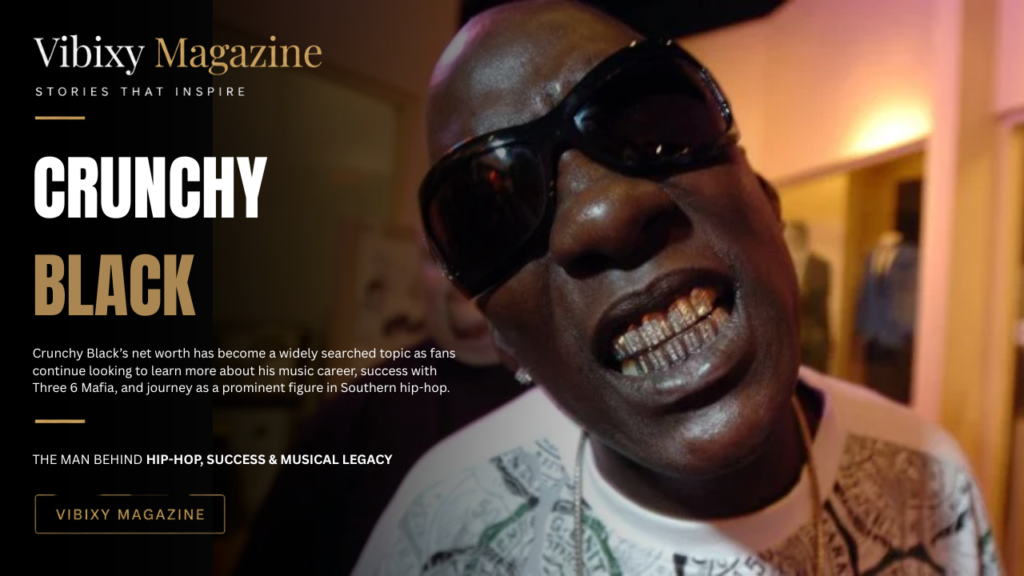
How Crunchy Black Joined Three 6 Mafia
Crunchy Black’s professional breakthrough came through Three 6 Mafia.
According to biographical sources, he joined the group around 1995, initially as a dancer.
That detail is easy to overlook, but it explains why his stage presence became such an important part of his identity.
Three 6 Mafia wasn’t built around a conventional frontman model. Its strength came from the chemistry between different personalities, voices, producers, and performers. Crunchy Black’s role developed within that larger ecosystem.
The group was already creating a dark, aggressive sound that would become one of the signatures of Memphis rap. The Memphis Music Hall of Fame describes the group’s early style as intense and lyrically dark, helping distinguish it from other Southern rap movements.
Over time, Three 6 Mafia moved from underground recognition toward national success.
Crunchy Black was there during that transformation.
The Rise of Three 6 Mafia
Three 6 Mafia’s story is central to understanding Crunchy Black’s career and, by extension, the discussions surrounding his net worth.
The group began in the early 1990s and developed a cult following before gaining much broader commercial attention. Mystic Stylez, released in 1995, became one of the defining projects associated with the group’s early identity.
Later releases expanded that audience.
Albums such as Da Unbreakables and Most Known Unknown helped establish Three 6 Mafia as more than an underground Memphis act. The group’s sound became influential far beyond Tennessee, feeding into the evolution of crunk, Southern rap, and later trap.
Crunchy Black’s role wasn’t always the conventional one fans associate with a chart-topping solo rapper. He was part of the collective chemistry.
That distinction is important.
The entertainment business doesn’t reward every contributor in exactly the same way, and group success doesn’t automatically translate into identical individual wealth. This is one reason why estimating Crunchy Black’s personal finances is much harder than simply looking at Three 6 Mafia’s overall success.
The Oscar Moment That Changed Everything
Few moments in Southern hip-hop history were as significant as Three 6 Mafia winning the Academy Award for Best Original Song in 2006.
The group won for “It’s Hard Out Here for a Pimp,” from Hustle & Flow. The Academy’s official records confirm the song won the 2006 Oscar for Original Song, with the songwriting credits going to Jordan Houston, Cedric Coleman, and Paul Beauregard.
The moment was historic.
Three 6 Mafia became the first hip-hop group to win an Academy Award for Best Original Song. Their performance and acceptance speech also became one of the most memorable moments of the ceremony.
Crunchy Black was part of the group during that era and was visible in the Oscar-era lineup.
For an artist who came out of Memphis’ underground scene, the journey from local clubs and tapes to Hollywood’s biggest awards stage was extraordinary.
And it explains why his career remains relevant.
Crunchy Black’s Solo Career
Leaving a successful group can be one of the most complicated decisions an artist makes.
Crunchy Black left Three 6 Mafia in 2006, with sources citing financial disagreements and his desire to pursue a solo career.
His solo discography includes On My Own and From Me to You, among other releases. MusicBrainz lists On My Own from 2006 and From Me to You from 2007 among his official release groups.
On My Own also reached the Billboard 200, appearing at No. 163 on the chart in October 2006.
That chart appearance matters because it provides a concrete measure of his solo reach.
He wasn’t simply using the Three 6 Mafia name to stay visible. He was building a separate catalog.
At the same time, solo success is difficult to compare with group success. Three 6 Mafia had a powerful collective brand, established production infrastructure, and a fan base built over many years. A solo artist stepping away from that machine naturally faces a different commercial environment.
Crunchy Black’s Music Style and Influence
Crunchy Black’s appeal has never depended entirely on technical lyrical complexity.
His strength is personality.
His delivery fits the gritty, bass-heavy Memphis aesthetic associated with Three 6 Mafia. He could function as an MC, hype man, dancer, and visual performer, giving the group’s records and live shows another layer of energy.
The music also reflects the environment from which it came.
Memphis rap historically developed with a willingness to experiment with dark themes, stripped-down rhythms, hypnotic loops, and unconventional vocal patterns. Three 6 Mafia helped take those ideas beyond the regional underground.
Crunchy Black’s contribution sits inside that larger movement.
For listeners who came to Southern rap through later artists, his work can sometimes sound like a historical bridge. Elements that became common in later trap and Southern hip-hop had already been circulating in Memphis years earlier.
That’s part of his cultural relevance.
What Were Crunchy Black’s Main Sources of Income?
No reliable public document provides a complete breakdown of Crunchy Black’s personal income.
Still, his career suggests several conventional revenue categories.
Music and Recording Royalties
His recordings with Three 6 Mafia and his solo material can generate income through various forms of music exploitation, depending on ownership and contractual arrangements.
The amount any artist actually receives can vary dramatically based on contracts, publishing ownership, master rights, splits, distributors, and expenses.
That’s why simply counting album releases isn’t enough to calculate wealth.
Live Performances
Touring and live appearances have historically been important income sources for hip-hop performers.
Crunchy Black’s recognizable identity makes him suitable for nostalgia tours, Southern hip-hop events, festivals, club appearances, and collaborations.
But again, individual performance income isn’t public enough to turn into a precise annual salary.
Features and Collaborations
Crunchy Black has continued appearing on recordings beyond the peak Three 6 Mafia period. His modern music footprint includes collaborations and releases listed across music platforms, including projects and singles appearing in recent years. Apple Music currently lists newer collaborations involving him.
These appearances help explain why his name continues to circulate among listeners.
Catalog Value
The most overlooked part of an established musician’s financial picture is often the catalog.
Old songs can find new audiences through streaming, movies, television, social media, playlists, samples, and cultural revivals.
A song released decades ago doesn’t necessarily stop producing value simply because its original promotional cycle has ended.
Crunchy Black Personal Life
Crunchy Black has kept many details of his private life away from the spotlight.
Public biographies identify a daughter, Ladee, but information about his wider family, education, relationships, and private finances remains limited or inconsistently reported.
That relative privacy is worth respecting.
Celebrity biography pages sometimes fill information gaps with assumptions, recycled claims, or details copied from other websites. A lack of public information doesn’t mean a missing fact should be invented.
For Crunchy Black, the strongest publicly documented story is his professional one.
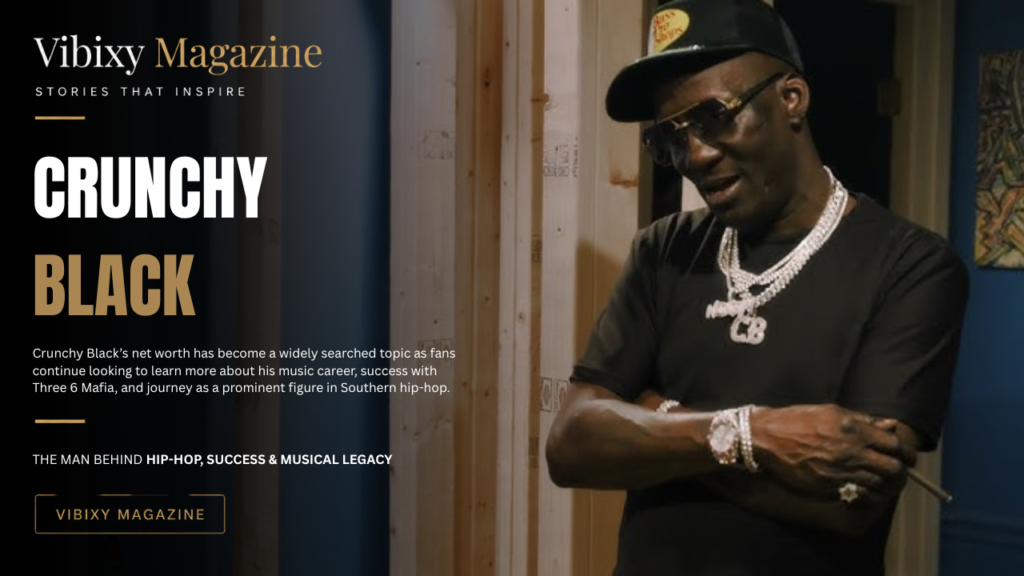
Crunchy Black on Social Media and Modern Fan Interest
The way fans discover older artists has changed dramatically.
A rapper no longer needs a new album to become relevant online. A short video, an old performance, a reunion, a podcast appearance, or a sample can suddenly send thousands of people searching for the artist’s name.
That is particularly true for musicians from influential regional scenes.
Crunchy Black’s connection to Three 6 Mafia gives him a built-in historical audience, while newer listeners continue discovering Memphis rap through streaming services and online clips. His music also remains available through major digital platforms, with Apple Music listing both older material and newer collaborations.
This helps explain why searches for his age, net worth, wife, daughter, and career continue to appear together.
Fans aren’t looking at isolated facts.
They’re reconstructing the life of an artist whose career spans multiple eras of hip-hop.
Why Is “Crunchy Black Net Worth” Trending?
The phrase can attract attention for several reasons.
First, celebrity net-worth searches naturally increase around birthdays, anniversaries, new interviews, music releases, documentaries, and renewed interest in classic groups.
Second, Three 6 Mafia’s influence has become increasingly visible to younger generations. Artists and producers working in modern Southern rap frequently draw from sounds that originated or developed in Memphis.
Third, Crunchy Black’s story contains an unusual contrast.
He was part of a group that reached an Academy Award stage, yet his individual finances are not nearly as transparent as those of many mainstream celebrities.
That gap creates curiosity.
People see the historical success and want to know what it meant personally.
Interesting Facts About Crunchy Black
One of the most interesting facts about Crunchy Black is that his career was connected to dance before it was primarily defined by recording music. He reportedly joined Three 6 Mafia initially as a dancer, which helps explain the importance of movement and stage presence in his public identity.
Another important detail is his association with G-Walking. He has described his involvement with the dance style while acknowledging that he did not invent the broader tradition.
He also participated in one of the biggest crossover moments in hip-hop history when Three 6 Mafia won the Academy Award for Best Original Song in 2006.
His solo album On My Own reached the Billboard 200 in 2006, showing that his post-group career generated measurable chart attention.
Finally, his career illustrates something that is often missed when discussing celebrity wealth: cultural influence and personal wealth are related, but they aren’t the same thing.
An artist can be historically important without having a publicly verifiable fortune.
Crunchy Black Career Timeline
| Year | Career milestone |
|---|---|
| 1974 | Birth year reported by multiple sources |
| Early 1990s | Becomes connected to Memphis’ rap scene |
| 1995 | Associated with Three 6 Mafia’s classic lineup |
| 1995 | Mystic Stylez era begins |
| 2003 | Three 6 Mafia releases Da Unbreakables |
| 2005 | Most Known Unknown and Hustle & Flow era |
| 2006 | Three 6 Mafia wins the Academy Award for Best Original Song |
| 2006 | Crunchy Black leaves Three 6 Mafia |
| 2006 | On My Own released |
| 2007 | From Me to You released |
| 2013 | Joins Da Mafia 6ix |
| 2020s | Continues appearing in recordings and collaborations |
| 2026 | Turns 52 according to the 1974 birth-year sources |
What Does the Future Look Like for Crunchy Black?
At this stage of his career, a conventional mainstream comeback isn’t necessarily the most interesting possibility.
Legacy artists have a different opportunity.
The rise of streaming, podcasts, documentaries, catalog-driven listening, reunion shows, and social media has created an audience for artists who were once considered part of a previous generation.
Crunchy Black’s strongest asset may therefore be his history.
He represents a period when Memphis rap was developing its identity outside the traditional centers of the music industry. Younger listeners who discover Three 6 Mafia today aren’t necessarily interested only in nostalgia. They are often looking backward to understand where modern Southern rap came from.
That gives Crunchy Black continuing relevance.
Future income could come from performances, collaborations, catalog exploitation, licensing, digital streaming, and appearances, although there is no reliable public basis for predicting exact earnings.
Crunchy Black Net Worth vs. Cultural Worth
There is an irony in the obsession with net worth.
A dollar figure is easy to search.
Influence is harder to measure.
Crunchy Black helped represent a Memphis sound that eventually reached one of the most prestigious stages in American entertainment. Three 6 Mafia’s Academy Award win demonstrated that Southern underground rap could move from local credibility to mainstream cultural recognition without losing all of its rough edges.
That legacy can’t be reduced to a bank balance.
Whether his actual net worth is closer to $6 million, $8 million, or something else entirely, the public record doesn’t justify pretending that an exact figure is known.
What can be said with confidence is that Crunchy Black built a career with real historical significance.
And in hip-hop, that kind of longevity has value of its own.
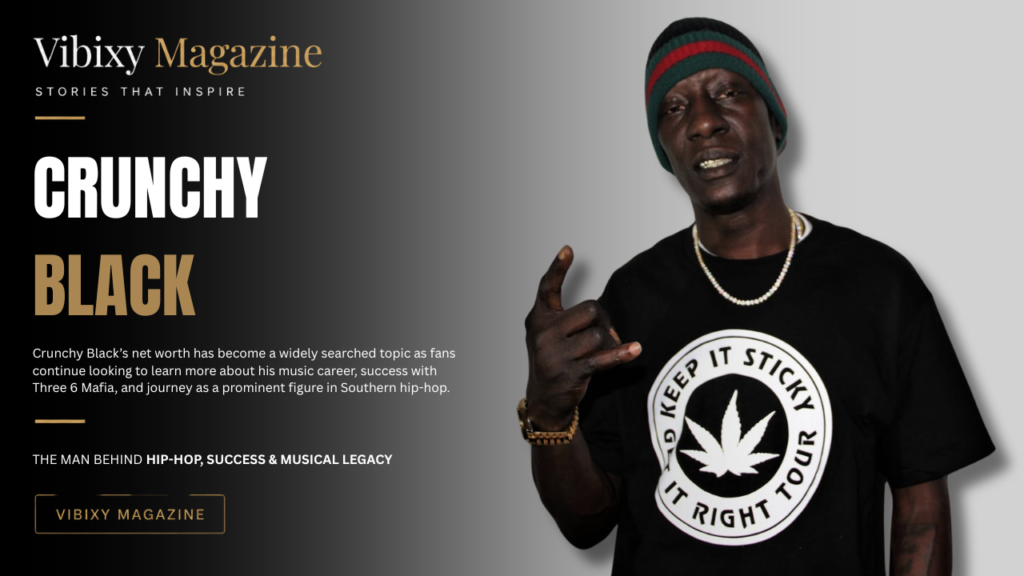
Frequently Asked Questions About Crunchy Black
What is Crunchy Black’s net worth?
Online estimates commonly place Crunchy Black’s net worth between approximately $6 million and $8 million. These figures are not independently verified financial disclosures, so they should be treated as estimates rather than confirmed wealth.
How old is Crunchy Black in 2026?
Using the August 20, 1974 birth date reported by multiple sources, Crunchy Black is 52 years old in 2026. Some databases list 1977 instead, which creates a three-year discrepancy in online biographies.
What is Crunchy Black’s real name?
His real name is Darnell Carlton, with some music databases listing the fuller name Darnell Lorenzo Carlton.
Was Crunchy Black in Three 6 Mafia?
Yes. Crunchy Black was part of Three 6 Mafia’s classic lineup and contributed as an MC. The Memphis Music Hall of Fame identifies him among the members added to the group by the time of Mystic Stylez.
Why did Crunchy Black leave Three 6 Mafia?
Biographical sources report that he left the group in 2006, citing financial disputes and a desire to pursue a solo career.
Did Crunchy Black win an Oscar?
Crunchy Black was a member of Three 6 Mafia during the group’s historic 2006 Academy Award win for Best Original Song for “It’s Hard Out Here for a Pimp.” The Academy officially records Three 6 Mafia as the winner.
What is Crunchy Black known for besides rapping?
He is also known for his energetic stage presence and association with G-Walking, a Memphis-related dance style. His career began partly through performance and dancing before his identity became more strongly associated with MC work.
Does Crunchy Black still make music?
Yes. His catalog and music-platform listings show continued appearances and collaborations beyond his classic Three 6 Mafia period. Apple Music, for example, currently lists newer releases and collaborations involving him.
What are Crunchy Black’s most important career achievements?
His most significant achievements include his work with Three 6 Mafia, participation in the group’s influential Memphis rap era, his solo releases, and his involvement in the group’s 2006 Academy Award-winning period.
Why do people search for Crunchy Black’s net worth?
The interest comes from a combination of nostalgia, curiosity about the financial rewards of Three 6 Mafia’s success, renewed interest in Memphis rap, and searches surrounding his age, career, family, and current activity.
Final Thoughts on Crunchy Black Net Worth
The search for Crunchy Black net worth is really a search for something bigger than money.
It’s a question about what decades in hip-hop can produce, what happens when an underground artist reaches the highest levels of popular culture, and whether that success can still be seen in the artist’s life years later.
The honest answer is that nobody outside Crunchy Black and those with access to his private financial records can confidently state his exact fortune. The $6 million to $8 million range appears repeatedly in online estimates, but those numbers should remain labeled as estimates.
His documented career tells a much stronger story.
From Memphis’ underground rap culture to Three 6 Mafia’s international recognition, from G-Walking to solo releases, and from local credibility to an Academy Award-winning group, Crunchy Black has remained connected to a chapter of hip-hop history that refuses to disappear.
That’s why people are still searching his name.
The money may be difficult to verify. The legacy isn’t.