
When people search for “judge Stephanie Boyd Wikipedia,” they’re usually looking for a quick biography: Who is she? How old is Judge Stephanie Boyd? Where is she from? What court does she oversee? Why has her name appeared so often in online searches?
The answers are more interesting than a standard Wikipedia-style profile might suggest.
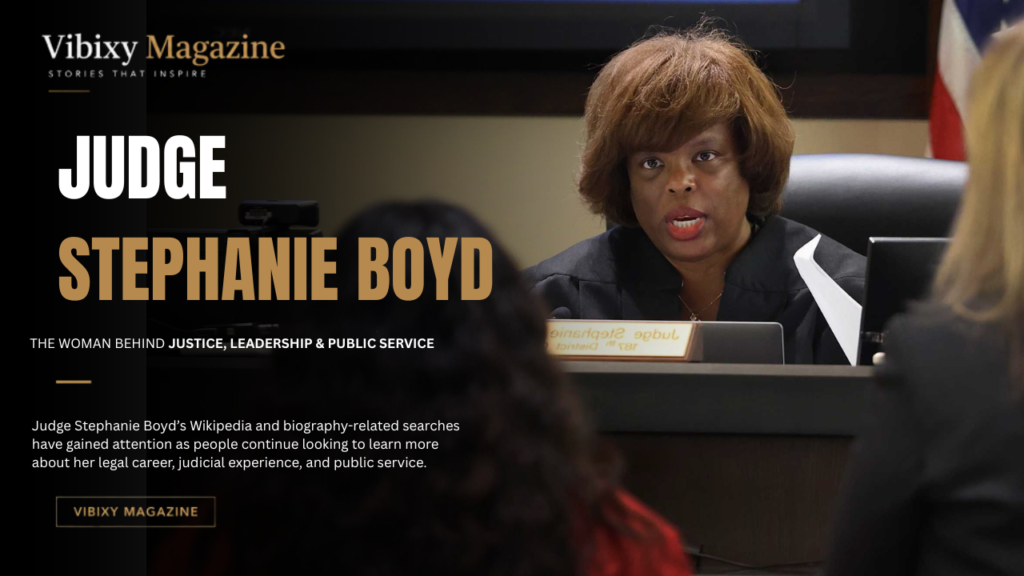
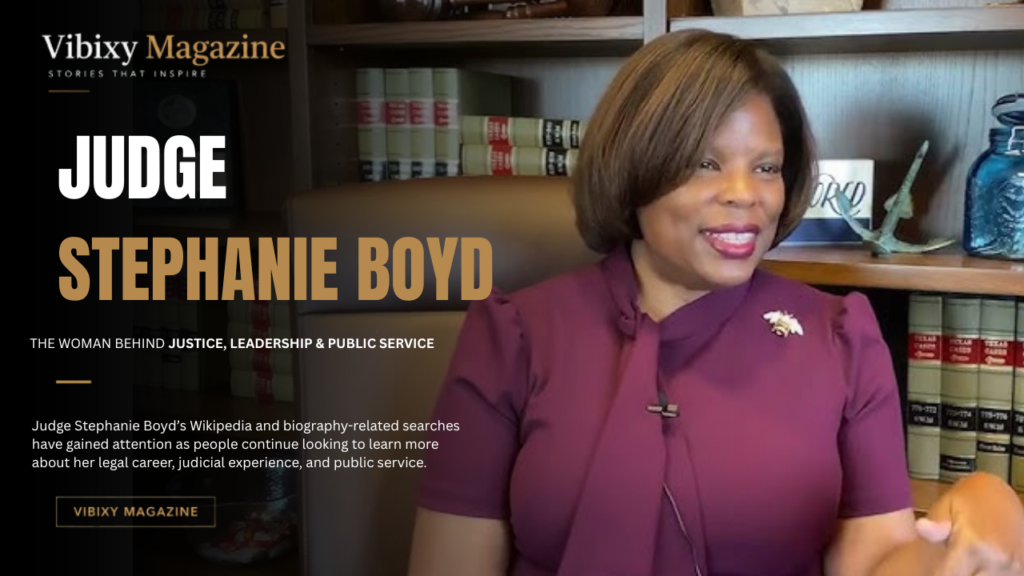
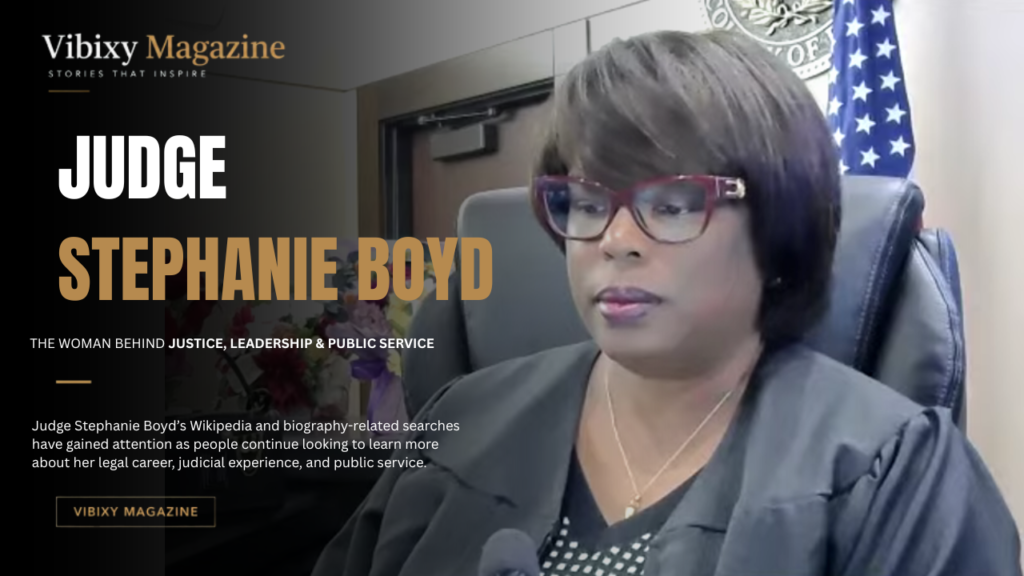
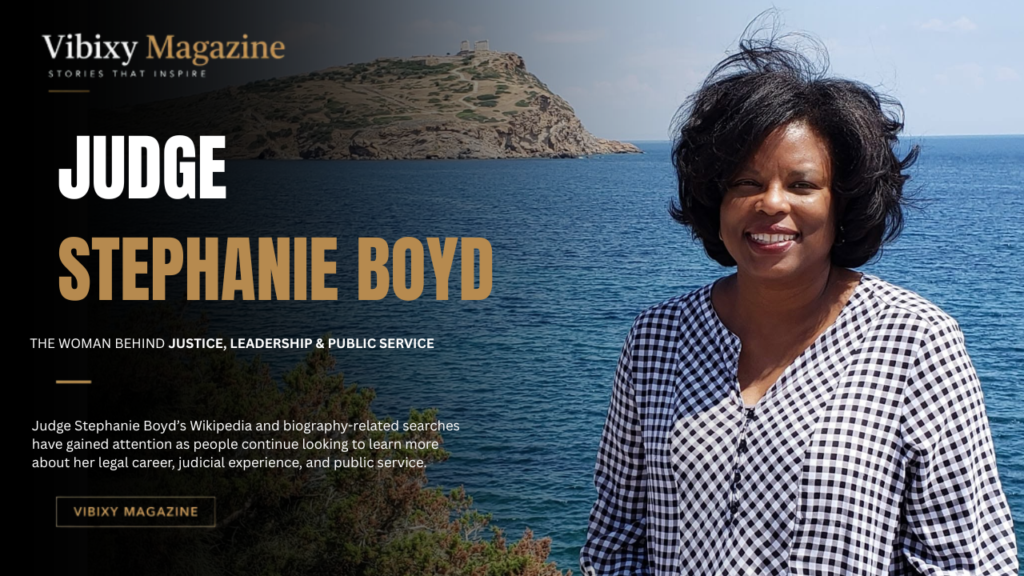
Judge Stephanie R. Boyd is a Texas attorney and jurist who became the presiding judge of the 187th Judicial District Court in Bexar County, San Antonio. She made history when she was elected to that position in 2018, becoming the first African American and first woman to preside over the 187th District Court, according to her campaign biography.
Her career has included work as a prosecutor, private criminal-defense attorney, community leader, educator and judge. But what has pushed her name beyond ordinary legal circles is her unusual approach to courtroom transparency: Boyd used YouTube to livestream proceedings, allowing members of the public to watch portions of the court’s work online. That decision generated both support and criticism and eventually became part of a broader controversy involving judicial conduct.
In 2026, another major chapter arrived. Boyd lost the Democratic primary for another term, and the Texas State Commission on Judicial Conduct issued a public warning concerning her courtroom conduct and use of the court’s YouTube channel. Her current judicial term is scheduled to end on December 31, 2026.
So, if you’re searching for a Judge Stephanie Boyd Wikipedia page, this is the fuller story.
Judge Stephanie Boyd Biography at a Glance
| Category | Details |
|---|---|
| Full name | Stephanie R. Boyd |
| Profession | Attorney, judge, educator |
| Birthplace | Shreveport, Louisiana |
| Court | 187th Judicial District Court |
| Location | Bexar County, San Antonio, Texas |
| First elected judge | 2018 |
| Reelected | 2022 |
| Political affiliation | Democrat |
| Law degree | St. Mary’s University School of Law |
| J.D. | 1997 |
| Legal background | Prosecutor, private criminal attorney, judge |
| Previous prosecutor role | Bexar County District Attorney’s Office |
| Judicial specialty | Felony criminal cases |
| Additional role | Felony Mental Health Court |
| Teaching | University of Texas at San Antonio |
| 2026 election | Lost Democratic primary |
| Current term | Ends December 31, 2026 |
| Major recent development | June 2026 public warning from Texas State Commission on Judicial Conduct |
Public biographical sources consistently identify Boyd as a Louisiana native who built her professional career in Texas. Her campaign biography says she earned a bachelor’s degree in political science, an MBA and a Juris Doctor degree from St. Mary’s University. Trellis likewise lists her J.D. from St. Mary’s University School of Law in 1997.
Who Is Judge Stephanie Boyd?
Judge Stephanie Boyd is a San Antonio-area criminal district judge whose career has largely revolved around criminal law and public service.
She was elected to the 187th District Court in 2018. The court handles felony criminal matters, placing the judge in a position where decisions can have enormous consequences for defendants, victims, families and the wider community.
Boyd’s background is broader than simply sitting on the bench. Before becoming a judge, she worked as a prosecutor and later established her own private practice. Her campaign biography states that she represented adults and juveniles and worked on cases involving children who were victims of abuse and neglect. She later joined the Bexar County District Attorney’s Office, where she served in the Special Crimes Unit and handled matters involving child abuse and domestic violence.
That mixture of prosecution and defense experience is significant. A judge who has worked on both sides of the courtroom has seen criminal cases from different angles. It doesn’t automatically tell us whether every ruling was correct, but it helps explain the professional background Boyd brought with her to the bench.
Her Historic Election
Boyd’s 2018 election was particularly significant in Bexar County.
She became the first African American and first female judge to preside over the 187th Judicial District Court, according to her official biography. Her election also occurred alongside the election of other Black judges, changing the racial representation of the county’s judiciary.
That history matters because judges aren’t simply legal decision-makers. They are also visible representatives of the justice system. For communities that have historically seen limited representation on the bench, the presence of a Black woman in a powerful criminal court position can carry meaning beyond an individual career.
Judge Stephanie Boyd Early Life and Family Background
Publicly available information about Boyd’s childhood is more limited than the material about her professional career.
Her official biography says she was born in Louisiana and describes her upbringing in terms of family, community and hard work. She was baptized at New Zion Baptist Church in Grand Cane, Louisiana. Her biography also credits her grandmother and mother with teaching her the value of history, work and community involvement.
One detail stands out because it gives a more personal glimpse into her early years.
According to the biography, Boyd began earning money at age 12 by selling Christmas cards door-to-door. During summers, she reportedly rode a bicycle with a yard rake positioned on the handlebars and earned money by cleaning up neighborhood yards.
Those anecdotes have become part of the public story she tells about herself. They frame her early life around independence rather than privilege: finding small opportunities, working for money and learning the value of community.
She also developed an interest in history at a young age. Her biography connects that interest with visits to nursing homes and conversations with older people, whose stories gave her a greater appreciation for previous generations.
Judge Stephanie Boyd Age: How Old Is She?
Age is one of the most frequently searched details surrounding public figures, and Judge Stephanie Boyd’s age is no exception.
The clearest recent public source is the San Antonio Report’s 2026 candidate profile, which identified Boyd as 58 years old during the 2026 election cycle.
That makes 58 the most defensible age figure to use based on the currently available public reporting.
However, there is an important distinction between a reported age and a fully documented birth date. Public biographies do not consistently provide a complete birth date, so it would be inappropriate to manufacture an exact birthday from an age figure alone.
Why Are People Searching for Judge Boyd’s Age?
The curiosity isn’t particularly surprising.
Boyd has been a public figure in San Antonio’s legal system for years, and her courtroom appearances are unusually accessible online because of the YouTube livestreaming system associated with her court. That means people who encounter her through a court video may become curious about the person behind the judicial robe.
Search behavior often follows that pattern: someone sees a courtroom personality, searches the name, then adds terms such as “age,” “Wikipedia,” “husband,” “salary” or “net worth.”
The problem is that search demand doesn’t automatically create reliable information.
A responsible biography should separate what is publicly documented from what internet users merely speculate about.
Judge Stephanie Boyd Education and Legal Training
Boyd’s educational background is one of the better-documented parts of her biography.
Her official biography states that she earned a Bachelor of Arts in Political Science, a Master of Business Administration, and a Juris Doctor from St. Mary’s University. Trellis independently identifies her J.D. from St. Mary’s University School of Law in 1997.
The combination is notable because her education wasn’t limited to law.
Political science provides a foundation in government and institutions. Business education can add another perspective on management and organizational decision-making. Legal education, of course, is the professional requirement that ultimately led to her courtroom career.
After law school, Boyd’s career developed through practical legal work rather than jumping directly into the judiciary.
Judge Stephanie Boyd Career Journey
Early Legal Career
Boyd’s legal career included work with the Bexar County District Attorney’s Office as an assistant district attorney, according to Trellis. She later operated as a sole practitioner in private practice, focusing on criminal law.
Her official biography says she established her private practice in 1997.
That timing is notable because it places the beginning of her private legal career at roughly the same point as her graduation from law school. Over the years, she accumulated experience representing different types of clients and handling difficult criminal matters.
Return to the District Attorney’s Office
In 2015, Boyd joined the Bexar County District Attorney’s Office, according to her campaign biography.
There, she served as a first-chair prosecutor in the Special Crimes Unit, working on cases involving child abuse and domestic violence.
This part of her career is especially relevant when considering the cases she would later encounter as a felony district judge. Criminal courts routinely require judges to understand complicated evidence, victim testimony, constitutional protections, sentencing considerations and competing interests.
Election to the Bench
Boyd won election to the 187th District Court in 2018 and was reelected in 2022.
Her judicial role placed her at the center of serious felony litigation in Bexar County.
Her biography also says she worked as presiding judge of the Felony Mental Health Court alongside Judge Ron Rangel, with a focus on helping defendants with mental-health challenges access appropriate resources while maintaining public safety.
That aspect of her work illustrates a broader trend in modern criminal justice: courts increasingly have to balance punishment with rehabilitation.
Judge Stephanie Boyd and YouTube: Why Did She Become So Well Known Online?
This is probably the most distinctive part of Boyd’s public profile.
During the COVID-19 pandemic, courts across the United States experimented with remote technology. Boyd embraced that shift and used Zoom and YouTube to make proceedings accessible to the public. Her campaign biography describes the practice as an effort to improve transparency.
But transparency created a new problem.
A courtroom isn’t the same thing as a television studio.
Once proceedings are streamed online, spectators can react in real time. A person who would never travel to a courthouse can suddenly watch hearings from home. And when a live comment section is involved, the boundary between observing a court proceeding and participating in an online community can become surprisingly blurry.
By 2024, Trellis reported that Boyd’s YouTube channel had approximately 23,800 subscribers, demonstrating that the courtroom stream had attracted an audience far larger than the handful of people who might normally sit in a courthouse gallery.
That online following helps explain why searches for Judge Stephanie Boyd have continued to grow.
The Criticism
Defense attorneys raised concerns about the livestreaming practice.
In 2023, an administrative judge granted recusals in three felony cases after complaints connected to the YouTube stream. The cases included an injury-to-a-child matter and two indecency-with-a-child cases.
San Antonio Express-News also reported concerns about inappropriate viewer comments and the atmosphere developing around the channel.
The dispute was never simply about whether a courtroom should be public. Courtrooms are traditionally open to the public. The harder question was what happens when public access is transformed into an always-on digital audience.
That question has implications far beyond Boyd.
What Happened to Judge Stephanie Boyd in 2026?
The biggest recent development came in June 2026.
The Texas State Commission on Judicial Conduct issued Boyd a public warning after reviewing issues involving courtroom conduct and her YouTube channel. According to KSAT, the commission found violations involving professional conduct, comments made during proceedings, interactions surrounding the YouTube channel and other judicial responsibilities.
The commission’s action followed scrutiny of two criminal hearings as well as Boyd’s online activity.
The warning became part of her permanent disciplinary record, but it did not remove her from office.
That distinction matters.
A public warning is not the same thing as removal from the bench, and an allegation is not the same thing as a finding. In Boyd’s case, the commission ultimately issued a formal warning after its review.
Boyd maintained that she did not rely on viewer comments or messages when making judicial decisions and said her rulings were based on evidence and law.
Did Judge Stephanie Boyd Lose Her Job?
Not immediately.
Boyd lost the Democratic primary for another term in 2026. Reporting from the San Antonio Express-News states that she lost to Stephanie Franco by just over 10,000 votes. Her current term is scheduled to conclude at the end of 2026.
That means the end of Boyd’s tenure is the result of the election outcome rather than the June disciplinary warning itself.
The distinction is easy to miss in social-media discussions, where separate events can quickly become blended together.
2026 Election Timeline
| Date/Period | Development |
|---|---|
| 2018 | Boyd elected to the 187th District Court |
| 2022 | Boyd reelected |
| 2023 | Three cases recused from her court amid YouTube-related controversy |
| 2024 | Her courtroom YouTube presence continued attracting substantial online attention |
| February 2026 | San Antonio Report profiled Boyd as a Democratic candidate |
| March 2026 | Boyd lost the Democratic primary to Stephanie Franco |
| June 3, 2026 | Texas State Commission on Judicial Conduct issued public warning |
| December 31, 2026 | Current term scheduled to end |
The sequence matters because Boyd’s public story isn’t reducible to a single controversy. Her career spans decades, and the YouTube dispute emerged after she had already established herself as a lawyer and judge.
Judge Stephanie Boyd Personal Life
Personal information about Boyd is considerably less extensive than her professional biography.
Reliable public sources focus primarily on her education, legal career, judicial work, community involvement and teaching. Her official biography discusses the influence of her mother and grandmother during childhood but does not provide extensive details about a spouse, children or private family life.
That makes caution especially important.
There are countless low-quality celebrity-style biography pages that fill gaps with assumptions. Unless a personal detail is confirmed by a reliable source or by Boyd herself, it shouldn’t be presented as fact.
For readers searching for “Judge Stephanie Boyd husband” or similar terms, the responsible answer is simple: her publicly documented professional biography provides much more information about her career than about her private relationships.
Does Judge Stephanie Boyd Have Social Media?
Boyd became particularly visible online through the YouTube presence associated with her courtroom.
Her use of YouTube wasn’t merely personal social media activity. It was tied to public access to court proceedings and became part of her broader philosophy of judicial transparency. Her biography says she continued using YouTube after the pandemic to make court proceedings more accessible.
That distinction is worth keeping in mind.
A judge streaming public proceedings isn’t necessarily behaving like an influencer. At the same time, once viewers gather around a channel, subscribe, comment and discuss courtroom participants, the experience can begin to resemble a social-media ecosystem.
That’s precisely why Boyd’s channel became such a fascinating case study in the changing relationship between courts and the internet.
Judge Stephanie Boyd Net Worth: Is There a Reliable Figure?
There is no reliable, authoritative public figure establishing Judge Stephanie Boyd’s personal net worth.
That means websites claiming an exact number should be treated skeptically unless they provide verifiable financial documentation.
Judges have public salaries and compensation structures, but salary is not the same thing as net worth. Net worth depends on assets, property, investments, debts, retirement accounts and other private financial information.
A journalist can responsibly report a public salary if documented. Turning that salary into an invented “net worth estimate” would be speculation.
So the most accurate answer to “Judge Stephanie Boyd net worth” is that her net worth has not been reliably established in the public sources reviewed for this biography.
Did Judge Stephanie Boyd Have Anything to Do With Music or Hip-Hop?
This is where online search behavior can create confusion.
There is no credible evidence in the sources reviewed that Judge Stephanie Boyd is a recording artist, rapper, singer or music-industry personality.
The available Stephanie Boyd is a Texas criminal judge and attorney.
That means searches or articles connecting her to music style, rap influences or a hip-hop career should not automatically be attributed to this judge. Similar names can belong to completely different people, and mixing those identities is one of the easiest ways for an online biography to become inaccurate.
Her relevance to internet culture comes from courtroom livestreaming and viral courtroom interest, not from music.
Why Is “Judge Stephanie Boyd Wikipedia” Trending?
The keyword has several likely drivers.
First, Boyd’s YouTube courtroom presence makes her more searchable than many judges. People who discover a courtroom clip often want background information immediately.
Second, the 2026 election changed her professional future. Her defeat in the Democratic primary generated additional reporting about her career and the future of the 187th District Court.
Third, the June 2026 judicial-conduct warning added another major news event to an already unusual public profile.
And finally, people use “Wikipedia” as a generic search shortcut. A person doesn’t necessarily need to have an actual Wikipedia biography for users to type “[name] Wikipedia” into Google. They may simply be looking for a centralized biography.
In Boyd’s case, the search itself reflects a broader internet phenomenon: people increasingly want to understand the personalities behind public institutions.
Cultural Relevance: When the Courtroom Becomes Content
Boyd’s story is bigger than one judge.
For generations, the courtroom was physically distant from most people’s daily lives. Unless someone was a lawyer, journalist, defendant, victim, family member or juror, they probably had little reason to spend time watching court proceedings.
YouTube changed that.
A viewer can now encounter a sentencing hearing while sitting at home, watch a judge question a defendant and then search the judge’s name five minutes later.
That’s how public officials become internet personalities without ever intending to become celebrities.
Boyd’s experience demonstrates both sides of that transformation.
Greater access can educate the public. People can see how hearings work, how judges communicate with attorneys and defendants, and how complicated legal decisions can be.
But increased visibility can also expose participants to harassment, commentary and context-free clips. A serious judicial proceeding can be reduced to a 45-second viral moment.
That tension will not disappear simply because Boyd’s term is ending.
What Could Be Next for Stephanie Boyd?
The end of her current judicial term does not necessarily mean the end of her legal career.
Boyd has decades of legal experience, including prosecution, defense work and judicial service. Her biography also says she teaches Trial Advocacy, Appellate Advocacy and Campaign and Election Law at the University of Texas at San Antonio.
Teaching could therefore remain an important part of her professional life.
Her future could also involve legal education, private practice, community work or other forms of public service. Predicting a specific next job would be premature, though.
One thing is clear: Boyd’s professional legacy will probably be discussed in two parallel ways.
One concerns representation, legal experience and her historic place on the Bexar County bench.
The other concerns judicial temperament, courtroom management and the complicated experiment of livestreaming criminal proceedings to a massive online audience.
Both belong in the record.
Interesting Facts About Judge Stephanie Boyd
A few details make Boyd’s biography particularly distinctive:
- She was born in Louisiana and later built her legal career in Texas.
- Her biography says she began working at age 12 selling Christmas cards.
- She reportedly earned summer income cleaning neighborhood yards.
- She became the first African American and first woman to preside over the 187th District Court.
- She has worked as both a prosecutor and private criminal attorney.
- She was elected to the bench in 2018 and reelected in 2022.
- She became known nationally within online legal circles because of courtroom livestreaming.
- Her YouTube presence reportedly had about 23,800 subscribers by 2024.
- Her court’s streaming practice generated legal controversy and resulted in three case recusals in 2023.
- She lost her 2026 Democratic primary to Stephanie Franco.
- The Texas State Commission on Judicial Conduct issued her a public warning in June 2026.
- She has also worked as a university instructor in legal subjects.
Judge Stephanie Boyd Wikipedia: Frequently Asked Questions
Is there a Wikipedia page for Judge Stephanie Boyd?
The search term “Judge Stephanie Boyd Wikipedia” does not by itself establish that a dedicated Wikipedia biography exists. The stronger sources currently available are her professional biography, legal databases, local journalism and reporting about her court and 2026 election.
For a factual biography, those sources are more useful than assuming that a Wikipedia-style page exists.
Who is Judge Stephanie Boyd?
Judge Stephanie R. Boyd is a Texas attorney and jurist who served as presiding judge of the 187th Judicial District Court in Bexar County, San Antonio. She was first elected in 2018 and reelected in 2022.
How old is Judge Stephanie Boyd?
The San Antonio Report identified Boyd as 58 years old in its 2026 candidate profile.
Where was Stephanie Boyd born?
Public biographical material identifies Boyd as a Louisiana native and gives Shreveport, Louisiana, as her birthplace.
When did Stephanie Boyd become a judge?
Boyd was elected to the 187th District Court in 2018. She won reelection in 2022.
Why is Judge Stephanie Boyd famous online?
Her biggest source of online attention has been her decision to livestream courtroom proceedings through YouTube. The practice was promoted as a transparency measure but also generated criticism from defense attorneys and eventually became part of a judicial-conduct controversy.
What happened to Judge Stephanie Boyd in 2026?
Boyd lost the Democratic primary for another term and is scheduled to leave the bench when her current term ends on December 31, 2026. In June 2026, the Texas State Commission on Judicial Conduct also issued her a public warning over conduct involving courtroom proceedings and her YouTube channel.
Did Judge Stephanie Boyd get removed from office?
No. The June 2026 public warning did not itself remove Boyd from the bench. Her departure is connected to her loss in the 2026 Democratic primary and the scheduled expiration of her current term.
What is Judge Stephanie Boyd’s net worth?
There is no reliably established public figure for Boyd’s personal net worth. Claims giving an exact amount should be considered unverified unless supported by credible financial records.
Is Judge Stephanie Boyd a musician or rapper?
No credible evidence reviewed for this article identifies the Texas judge as a recording artist or rapper. Search results involving music or hip-hop may concern another person with the same or a similar name.
What will Stephanie Boyd do after leaving the bench?
Her next career move has not been definitively established. Given her background in prosecution, criminal defense, judging and legal education, several professional paths could be possible, but it would be speculation to name a specific future position without confirmation.
Final Thoughts on Judge Stephanie Boyd
The most interesting thing about Judge Stephanie Boyd isn’t a mysterious celebrity lifestyle or an easily packaged Wikipedia biography. It’s the unusual intersection of law, representation, technology and public attention that has defined her career.
She entered public life through the traditional route of legal education, prosecution and courtroom practice. She became a historic figure in Bexar County when she took the bench at the 187th District Court. Then she did something relatively unusual for a criminal judge: she brought the courtroom to YouTube.
That decision changed the scale of her audience.
Supporters saw transparency. Critics saw risks that come with exposing sensitive criminal proceedings to an online audience. The debate eventually became part of the larger story surrounding her judicial career, culminating in a 2026 public warning from the Texas State Commission on Judicial Conduct.
Her electoral defeat means another chapter is closing. Yet the questions raised by her career are likely to remain relevant: How much access should the public have to criminal courts? Where should the line between transparency and spectacle be drawn? And what happens when a judge becomes recognizable not because she sought celebrity, but because technology placed her courtroom in front of thousands of strangers?
Those questions make the Judge Stephanie Boyd Wikipedia search more than a request for basic facts. It is really a search for context — and context is what makes her story worth understanding.